
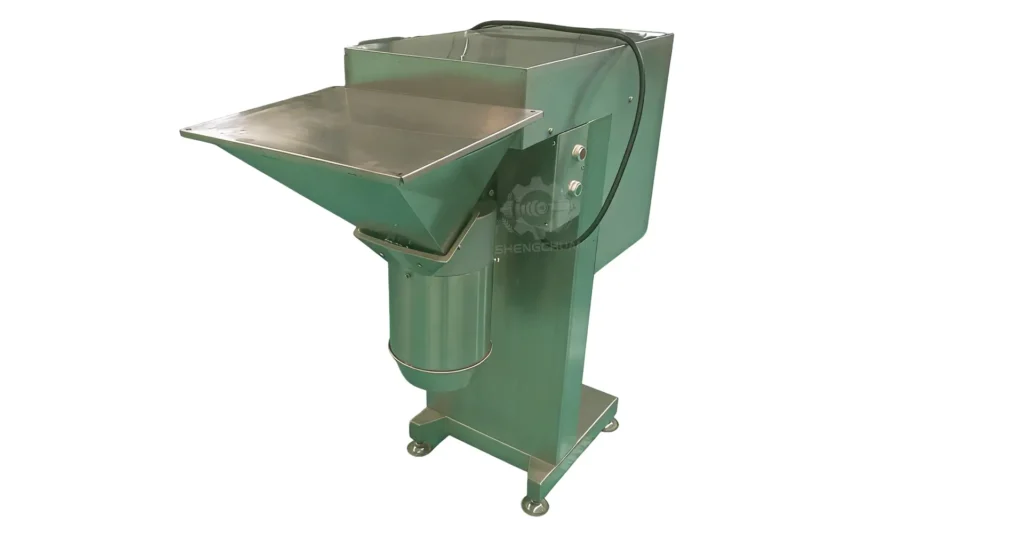
If you’re in the food processing industry—whether running a small restaurant, a condiment factory, or a large-scale ginger deep processing enterprise—you know how crucial efficient ginger preparation is. Ginger, with its unique flavor and medicinal properties, is a staple in cuisines and products worldwide, but manual grinding is time-consuming, labor-intensive, and inconsistent. That’s where a ginger grinder comes in. But have you ever wondered how this essential machine turns tough ginger rhizomes into fine powder, smooth paste, or uniform chunks? In this blog, we’ll break down the working principle of a ginger grinder, its key components, and why it’s a game-changer for your food business.
What Is a Ginger Grinder, Exactly?
First, let’s clarify: a ginger grinder is a specialized food processing machine designed to crush, grind, and chop ginger into the desired consistency—from coarse pieces to fine powder or smooth paste. Unlike general-purpose grinders, it’s engineered to handle ginger’s unique texture: fibrous, slightly moist, and sometimes tough, especially when dried. High-quality ginger grinders are made of food-grade stainless steel, meet GMP standards for food and drug production, and can also process similar ingredients like garlic, chili, herbs, and onions. They come in various types (dry grinding, wet grinding, industrial-grade, commercial) to suit different business needs, but their core working principle remains consistent.
The Core Working Principle of a Ginger Grinder
At its heart, a ginger grinder operates on the principle of high-speed relative motion between internal components, combined with impact, friction, and collision forces. Every part of the machine works together to break down ginger efficiently, while preserving its flavor, aroma, and nutritional value. Let’s break the process into 4 simple steps:
Step 1: Feeding the Ginger
The process starts with feeding prepared ginger into the machine’s feed opening. Most ginger grinders have a hopper with a smooth, rounded edge to prevent hand injuries, and some are equipped with a rotatable screw outside the hopper to control the feeding speed—ensuring the machine isn’t overloaded and the grinding is consistent. For optimal results, ginger is usually pre-washed, peeled, and cut into small chunks (1-2 inches) to make feeding easier and reduce strain on the machine. This pre-processing step also ensures no dirt or impurities enter the grinding chamber, maintaining hygiene.
Step 2: Grinding Chamber – The “Powerhouse” of the Machine
The grinding chamber is where the magic happens. Inside this sealed chamber, you’ll find two key components: a fixed fluted disc (or tooth plate) and a movable fluted disc (or tooth plate) [7]. The movable disc is connected to a high-speed motor, while the fixed disc remains stationary. When the machine is turned on, the movable disc rotates at extremely high speeds (usually 2,000-3,000 RPM, depending on the model).
As ginger enters the chamber, it’s caught between the rotating movable disc and the fixed disc. The fluted (or toothed) surfaces of these discs create intense friction and impact forces. The high hardness of the fixed disc and the high speed of the movable disc work together to thoroughly crush the ginger—breaking down its fibrous structure through three key actions: impact (from the rotating disc hitting the ginger), shear friction (between the two discs), and collision (between ginger particles themselves) [7]. This ensures even grinding, regardless of whether the ginger is fresh or dried.
Some advanced models also feature a cooling system: rotating leaves inside the chamber blow out air, reducing heat buildup. This is critical for preserving ginger’s natural oils, aroma, and nutritional properties, as excessive heat can degrade these components—especially important for heat-sensitive or sticky materials.
Step 3: Sieving and Classification
Once the ginger is crushed, it passes through a mesh screen (or sieve) located at the bottom of the grinding chamber. The screen’s mesh size determines the final consistency of the product: finer meshes (10-120 mesh) produce fine powder, while coarser meshes result in chunks or paste [1][7]. Any ginger particles that are too large to pass through the screen are recirculated back into the grinding chamber for further processing, ensuring uniform fineness.
For industrial-grade machines, this step may also include a cyclone separator and pulse dust collection device. The rotating centrifugal force and fan suction move the crushed ginger through the cyclone separator, while the dust collection box captures any fine particles—keeping the workspace clean and reducing waste.
Step 4: Discharging the Final Product
The final step is discharging the ground ginger. The ground material—whether powder, paste, or chunks—passes through the screen and exits the machine through a wide, stainless steel discharge port. This port is designed for fast, smooth discharge and easy cleaning, which is essential for maintaining food hygiene standards . Some automatic models even feature an automatic discharge device, further reducing manual labor and improving efficiency.