
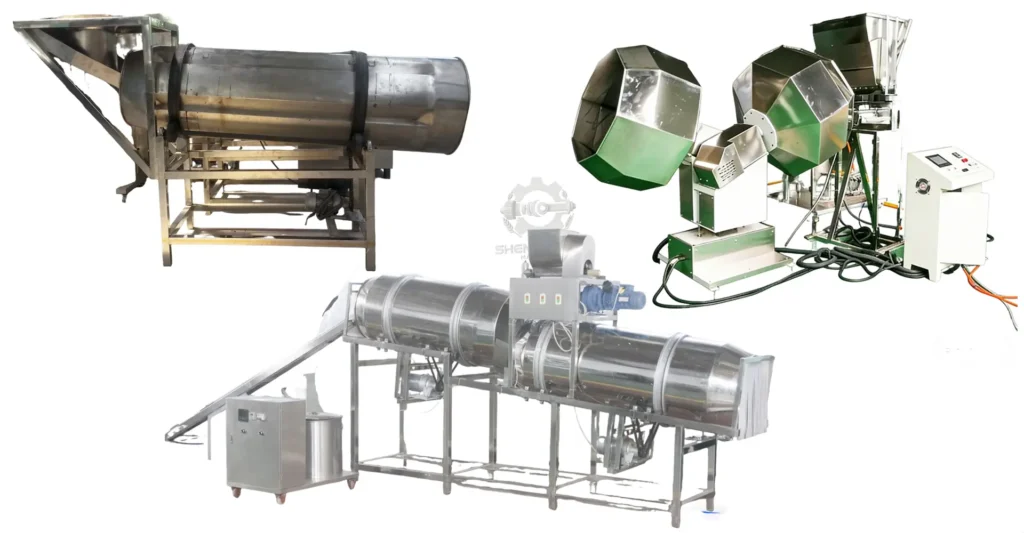
In the food processing industry, drum-type seasoning machines serve as core equipment for the seasoning process of leisure foods (e.g., potato chips, rice crackers, puffed foods) and pet foods. Among these, double drum, single drum, and octagonal drum seasoning machines are widely utilized in production scenarios of varying scales and requirements, owing to their distinct structural characteristics and performance advantages. This article systematically sorts out the commonalities and core differences of these three types of equipment, aiming to assist practitioners in accurate model selection and efficient application.
I. Commonalities of the Three Types of Seasoning Machines
Despite differences in structure and performance among the three types of seasoning machines, as homologous seasoning equipment, they maintain a high degree of consistency in core functions, design concepts, and application foundations, which are specifically reflected in the following four aspects:
(I) Consistent Core Functions
The core function of all three types is to achieve uniform mixing of materials and seasonings (including powder, particles, sauce, oil, etc.). Through mechanical movement, seasonings are firmly adhered to the surface of materials, thereby enhancing the consistency of food flavor. Meanwhile, they are capable of completing auxiliary processes such as oil spraying, sugar spraying, and powder coating, catering to diverse seasoning demands and adapting to the processing scenarios of various products, including puffed foods, fried foods, and pet foods.
(II) Common Basic Design
1. Uniform Material: All three types adopt food-grade 304 stainless steel as the core material. The inner wall of the drum is smooth without welding dead corners, complying with the national food contact material safety standard GB 4806.9-2016. It possesses the characteristics of corrosion resistance, easy cleaning, and no residue, ensuring food hygiene and safety;
2. Feeding and Discharging Design: All models support automatic feeding via elevators to realize continuous operation, with a convenient discharging method. Rapid discharging can be achieved through drum tilting, quick-dismantling structures, and other means, reducing the intensity of manual operations;
3. Seasoning Supply System: All are equipped with screw-type quantitative feeding devices and spreading mechanisms, and some can be optionally equipped with atomizing liquid spraying devices. These components can accurately control the dosage of seasonings, ensure seasoning uniformity, and avoid raw material waste.
(III) Homologous Working Principles
All three types rely on the rotational movement of the drum to drive materials to roll, sprinkle, and slide within the drum, enabling full contact between materials and seasonings. Essentially, they break the agglomeration state of materials through mechanical force, expand the contact area between seasonings and materials, and achieve the seasoning effect of “physical mixing + surface adhesion”. All models support frequency conversion speed regulation, allowing for adjustment of the rotational speed according to material characteristics.
(IV) Overlapping Adaptable Scenarios
All three types can be applied to the seasoning processing of various puffed foods and fried foods, and are capable of handling materials of various forms, such as blocks, slices, and particles (e.g., potato chips, French fries, peanuts, puffed rice cakes). Meanwhile, they can adapt to seasonings of various forms, including powder, oil, and sauce, exhibiting a certain degree of versatility.
II. Core Differences of the Three Types of Seasoning Machines
The core differences among the three types of equipment stem from variations in drum structure design, which result in significant differences in their movement trajectories, seasoning accuracy, production capacity and efficiency, applicable scenarios, and other aspects. The specific differences are elaborated in detail from the following six dimensions, combined with measured data and structural characteristics:
(I) Core Structural Differences (The Most Essential Difference)
1. Single Drum Seasoning Machine: It adopts a single cylindrical drum structure. The drum is formed by one-time pressing, and its inner wall is usually equipped with spiral guide ribs. No additional auxiliary drums are provided. The overall structure is simple, with few components and a relatively compact footprint, and its installed power is low (usually 0.75-2.2KW).
2. Double Drum Seasoning Machine: It adopts a double drum design arranged in parallel vertically or in series horizontally. The two drums are independently driven and can achieve differential rotation (the speed of the upper drum is 10-30r/min, slightly higher than that of the lower drum at 8-25r/min). The inner wall is evenly distributed with spiral guide ribs (with an adjustable pitch of 50-100mm). Some models adopt an inner-outer nested dual-power structure, equipped with segmental temperature control and a dual-mode common rail seasoning system. The structure is relatively complex, and its installed power is higher than that of the single drum seasoning machine (usually 2.2-5.5KW).
3. Octagonal Drum Seasoning Machine: Its core component is a drum with a regular octagonal cross-section (non-cylindrical), without additional auxiliary drums. The drum is formed by one-time pressing, and its eight edges form a unique material sliding path. The inner wall is smooth or equipped with a simple flow guide structure. Its structure is between that of the single drum and double drum seasoning machines, and its installed power is similar to that of the single drum seasoning machine (usually 0.75-2.2KW).
(II) Differences in Working Principles and Seasoning Effects
1. Single Drum Seasoning Machine: Within a single drum, materials move forward in a spiral rolling manner under the action of gravity and drum wall friction. The movement trajectory is relatively single, with certain rolling dead corners. The fluctuation of the average residence time of materials is significant (with a standard deviation of up to 18.3%), the seasoning uniformity is approximately 85%-90%, some materials may experience local agglomeration and uneven seasoning, and the oil spraying weight deviation is about ±5.8g/10kg.
2. Double Drum Seasoning Machine: Through the differential movement of the double drums, a composite movement trajectory of “rubbing + rolling” is formed, or a segmented process of “oil spraying in the front section and powder spreading in the rear section” is adopted to achieve precise seasoning of “priming first and feeding later”. Materials undergo an average of 17 effective turnovers within the drum, the seasoning uniformity is ≥98%, the coefficient of variation (CV value) of seasoning powder adhesion can be reduced to 6.2%, and the oil spraying weight deviation is narrowed to ±1.3g/10kg, which can effectively avoid dead corner residues and material agglomeration. Meanwhile, segmental temperature control can be adopted to reduce the loss of heat-sensitive flavor substances, with the retention rate of key aroma components reaching 89.2%.
3. Octagonal Drum Seasoning Machine: Utilizing the edges of the octagonal drum, materials form eight regular sliding paths during rotation. During the rolling process, they exhibit a cyclic movement of “sprinkling – falling – colliding”, which reduces material agglomeration compared with the single drum seasoning machine and eliminates obvious rolling dead corners. The material suspension time is extended by 1.8 times, and the seasoning uniformity can reach 92%-95%, which is between that of the single drum and double drum seasoning machines. It can effectively solve the problem of “floating capping and insufficient flavor at the bottom” of cylindrical drums.
(III) Differences in Production Capacity and Efficiency
1. Single Drum Seasoning Machine: Its production capacity is relatively low, with a single processing capacity of usually 50-200kg/h, making it suitable for small and medium-sized production or small-batch multi-variety trial production. The comprehensive utilization rate of the equipment is approximately 61%, and the model change and commissioning cycle is long (often exceeding 72 hours).
2. Double Drum Seasoning Machine: It boasts the highest production capacity, with a single processing capacity of up to 50-500kg/h, and some large-scale models can achieve even higher production capacity. It is suitable for large-scale continuous production. The comprehensive utilization rate of the equipment is increased to 89%, the model change and commissioning time is short (an average of 9.3 hours), and its energy consumption is 15%-20% lower than that of traditional single drum equipment, with lower power consumption per ton of products.
3. Octagonal Drum Seasoning Machine: Its production capacity is medium, with a single processing capacity of approximately 100-250kg/h, catering to both small-scale production and batch production needs. Its efficiency is superior to that of the single drum seasoning machine, the difficulty of model change and commissioning is moderate, and it is suitable for enterprises with certain requirements on seasoning uniformity but not high production capacity demands.
(IV) Differences in Material Adaptability
1. Single Drum Seasoning Machine: It has a wide adaptability range but poor adaptability to light materials (density < 0.35g/cm³), fragile materials (e.g., popcorn), and materials with an aspect ratio > 4. It is prone to material idling and high breakage rates, resulting in a low finished product integrity rate.
2. Double Drum Seasoning Machine: It exhibits the strongest material adaptability. Through modular drum design and differential speed adjustment, it can adapt to materials with various characteristics, such as light weight, fragility, and high elasticity (e.g., popcorn, pet chews, puffed rice cakes). It can reduce the material collision breakage rate, with the finished product integrity rate being 23% higher than that of the single drum seasoning machine. Meanwhile, it can adapt to seasonings of various forms, including powder, sauce, and oil, and supports dual-mode common rail switching.
3. Octagonal Drum Seasoning Machine: It is more suitable for granular and block materials (e.g., peanuts, broad beans, spicy strips). Its protection effect on fragile materials is superior to that of the single drum seasoning machine, but its adaptability to light materials is not as good as that of the double drum seasoning machine, and it is not suitable for processing high-viscosity sauce seasoning requirements.
(V) Differences in Operation and Maintenance
1. Single Drum Seasoning Machine: Its structure is simple, with a low operation threshold and moderate visualization. It is not equipped with a complex control system. Daily maintenance only requires cleaning the drum and inspecting the feeding mechanism, with low maintenance costs. The drum can be disassembled and cleaned within 5 minutes, and the residue detection value is < 5ppm.
2. Double Drum Seasoning Machine: Its operation is relatively complex. It is equipped with a visual touch interface, integrating one-key setting of parameters such as seasoning time, rotational speed, and feeding amount, and supports the storage of 10-12 groups of common formulas. It can be seamlessly connected to the MES system to realize intelligent closed-loop control. However, its maintenance cost is high. It is necessary to regularly inspect the synchronization of the double drums, the atomization effect of the liquid spraying device, and the thermal conductivity of the insulation jacket. The quick-dismantling structure can shorten the maintenance downtime by 65%.
3. Octagonal Drum Seasoning Machine: Its operation difficulty is between that of the single drum and double drum seasoning machines. No complex commissioning is required. It is equipped with a frame-type frame, and the drum tilting angle can be controlled by a hand pressure handle to realize discharging. The focus of maintenance is to clean the edge gaps of the octagonal drum (to avoid seasoning residue). Its maintenance cost is medium, and disassembly and cleaning are convenient.
(VI) Differences in Applicable Scenarios
1. Single Drum Seasoning Machine: It is suitable for small food processing plants, start-up enterprises, or for trial production and small-batch production. It is particularly suitable for mature product varieties with loose seasoning requirements and low model change frequency, such as ordinary puffed foods and fried peanuts. It offers high cost performance and the lowest initial investment cost.
2. Double Drum Seasoning Machine: It is suitable for large food processing plants and large-scale production lines. It is particularly suitable for scenarios with high requirements on seasoning accuracy, production capacity, and efficiency, such as mass production lines of leading leisure food enterprises and pet food production lines. It can meet the requirements of precise control of salt and fat reduction, small-batch multi-flavor model change, compliance testing, and other needs. Although its initial investment cost is the highest, its long-term operational cost performance is prominent.
3. Octagonal Drum Seasoning Machine: It is suitable for medium-sized food processing plants, balancing seasoning uniformity and cost. It is suitable for producing products with certain requirements on seasoning consistency, such as potato chips, French fries, and fruit crisps. It is particularly effective in solving the problems of material agglomeration and uneven seasoning associated with cylindrical drums. Its initial investment cost is between that of the single drum and double drum seasoning machines.
III. Summary
The core commonality of the three types of seasoning machines lies in “achieving uniform mixing of materials and seasonings through mechanical rolling”. All are suitable for the basic seasoning needs of food processing and possess basic advantages such as food-grade materials, automatic feeding, and quantitative seasoning. The core differences focus on seasoning accuracy, production capacity and efficiency, and material adaptability brought about by the drum structure — the single drum seasoning machine is superior in simplicity and economy, suitable for small-scale mass production; the double drum seasoning machine excels in precision and efficiency, suitable for large-scale and high-precision requirements; the octagonal drum seasoning machine balances uniformity and cost performance, suitable for diversified production of medium-sized enterprises.
When selecting models, practitioners can prioritize matching the production capacity and adaptability of the equipment according to their own production scale, material characteristics, seasoning accuracy requirements, and budget: select the single drum seasoning machine for small-scale trial production, the double drum seasoning machine for large-scale and high-precision mass production, and the octagonal drum seasoning machine for medium-sized enterprises to balance uniformity and cost. This ensures that the equipment is accurately matched with production needs, thereby improving production efficiency and product quality.