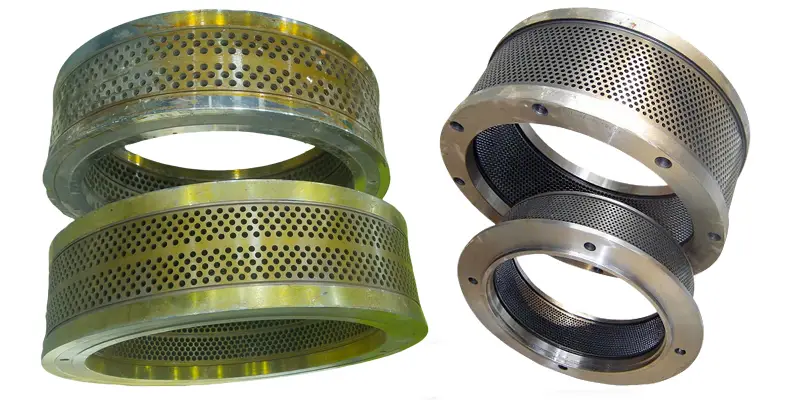
| Installation Orientation | Vertical axis installation; Die remains stationary while rollers rotate | Horizontal axis installation; Die rotates at high speed while rollers remain fixed |
| Feeding & Discharging | Vertical gravity feeding; Material enters the pressing chamber directly; Vertical discharge | Forced screw feeding; Material makes a 90° turn into the die; Horizontal discharge |
| Structural Appearance | Straight cylindrical design, no complex mounting flanges, flat sides | With mounting flanges/shoulders on both sides for horizontal equipment positioning |
| Die Hole Design | Straight-through holes, evenly distributed; Some models are reversible for double-sided use | Holes usually have feed chamfers; Hole distribution optimized for horizontal feeding |
| Primary Application | Biomass pellet mills (sawdust, straw, rice husk, etc.) | Traditional feed pellet mills, also used for some biomass materials |
| Speed & Torque | Low speed (~75 RPM), high torque; Uniform die wear | High speed (200+ RPM), lower torque; Uneven local wear |
| Material Compatibility | Ideal for light, low-flow biomass materials; No bridging issues | Suitable for wet, viscous feed materials; Poor compatibility with light biomass |
| Pellet Quality | High density, smooth surface, uniform length, minimal secondary breakage | Pellets prone to secondary impact; Rough surface, higher dust rate |
| Heat Dissipation & Service Life | Vertical structure facilitates heat dissipation; Even wear leads to longer life | High-speed friction generates significant heat; Prone to local overheating and wear |
| Maintenance & Replacement | Simple replacement; Reversible models allow double-sided use | Requires disassembly of both flanges; More complex replacement process |
| Key Foreign Trade Keywords | Vertical Ring Die for Biomass Pellet Mill, Wood Pellet Die | Horizontal Ring Die for Feed Pellet Mill, Animal Feed Pellet Die |