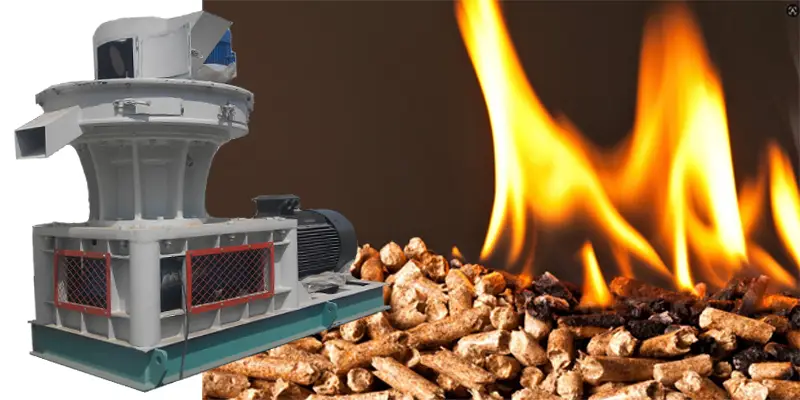
A vertical ring die pellet mill is a high-efficiency machine that compresses loose powder or fibrous materials into dense, uniform pellets. Its core design—vertical feeding, stationary ring die, rotating pressure rollers—enables stable, high-yield production for biomass fuels, animal feed, and organic fertilizers.
Core Structure Overview
The machine consists of these key components:
- Feeding System: Top-mounted hopper + variable-speed feeder for uniform material input
- Conditioner: Mixes raw materials with steam/water to soften and preheat
- Pelletizing Chamber: Core working area with stationary vertical ring die and rotating pressure rollers
- Cutting System: Adjustable knives to cut extruded pellets to desired lengths
- Drive System: Gearbox + motor for high-torque, stable rotation
- Lubrication System: Automatic lubrication for long-term, low-friction operation
Step-by-Step Working Principle
1. Vertical Gravity Feeding
Raw materials (sawdust, straw, feed powder) fall vertically from the top hopper by gravity into the pelletizing chamber.
- No forced feeding needed
- Prevents blockages and material bridging
- Ensures even distribution around the ring die
2. Material Conditioning
In the conditioner:
- Materials mix with steam/water
- Temperature rises to 70–90°C
- Fibers soften; lignin (natural binder) melts
- Improves pellet density and durability
3. High-Pressure Pelletizing (Core Step)
Inside the pelletizing chamber:
- Ring die: Stationary vertical ring with hundreds of precision holes
- Pressure rollers: 3–4 rotating rollers pressed tightly against the die inner wall
- Centrifugal force: Rotating rollers throw material evenly onto the die surface
- High-pressure extrusion: Rollers compress material through die holes
- Heat generation: Friction produces 80–120°C heat, activating lignin to bind particles
4. Pellet Cutting & Discharge
- Extruded cylindrical pellets exit the die
- Adjustable knives cut them to 6–12mm length
- Finished pellets fall to the discharge port
5. Cooling & Finishing
- Hot pellets go to a cooler to reduce moisture
- Ready for packaging or further processing
Key Advantages of Vertical Ring Die Design
- Superior Material Distribution
- Vertical structure + centrifugal force = even material spread
- Uniform wear on die and rollers
- Consistent pellet quality
- High Efficiency & Output
- Gear drive (98% efficiency)
- 0.3–4 tons/hour capacity (varies by model)
- Stable operation for 24-hour production
- Excellent Heat Dissipation
- Vertical ring die design allows natural heat escape
- Extends die/roller life; reduces thermal stress
- Low Maintenance
- Easy access for die/roller replacement
- Double-layer die (dual use, lower cost)
- Automatic lubrication system
- Wide Material Compatibility
- Processes hard-to-bind materials: rice husk, hardwood, straw
- Suitable for biomass fuels, animal feed, organic fertilizers
Typical Applications
- Biomass Fuel: Sawdust, wood chips, straw, rice husk pellets
- Animal Feed: Poultry, livestock, aquafeed pellets
- Organic Fertilizer: Compost, manure, agricultural waste pellets
Summary
The vertical ring die pellet mill’s working principle relies on gravity feeding, centrifugal distribution, and high-pressure extrusion between a stationary ring die and rotating rollers. This design delivers high efficiency, uniform pellets, low maintenance, and wide material compatibility, making it ideal for large-scale pellet production in biomass, feed, and fertilizer industries.