1. Core Introduction
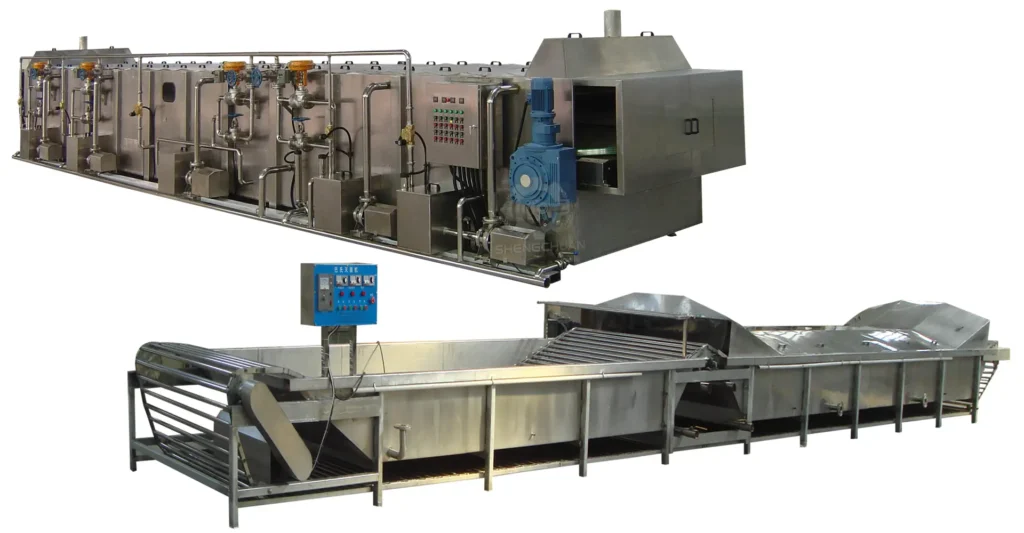
Tunnel Spray Type Pasteurizer
This is a Continuous Spray Tunnel Pasteurizer designed for high-volume, continuous production in the food & beverage industry. It adopts a closed tunnel structure and uses high-pressure circulating water sprayed from precision nozzles to heat/cool packaged products. The entire process is fully automated with a PLC control system, ensuring precise temperature control (±0.5℃ temperature fluctuation) and stepless speed adjustment of the conveyor system.
Constructed entirely from food-grade SUS304 stainless steel, it features a multi-stage temperature zoning design (preheating → pasteurization → precooling → cooling) and a high-efficiency heat recovery system. It is ideal for glass bottles, aluminum cans, PET bottles, and rigid flexible packaging, providing gentle treatment to avoid package damage while meeting strict food safety standards.
Water Bath Type Pasteurizer
This is a Continuous Water Immersion Pasteurization Line that submerges packaged products entirely in constant-temperature hot water for heat transfer. It consists of a stainless steel water tank, adjustable-speed mesh belt/roller conveyor, heating system, and cooling section. The product is transported through the hot water bath via the mesh belt, with temperature automatically controlled by a PID system to maintain a uniform heating environment.
Made of durable SUS304 stainless steel, it integrates pasteurization, cooling, and air-drying functions in one system. Its simple structure and low maintenance requirements make it suitable for soft packaging (vacuum bags, aluminum foil bags), high-viscosity products (sauces, porridges), pickled vegetables, and meat products, ensuring thorough and uniform sterilization without dead ends.
2. Key Similarities
- Core Principle: Both adopt the Pasteurization process (60-95℃ low-temperature heat treatment) to eliminate pathogenic bacteria and spoilage microorganisms while preserving the original flavor, nutrition, and texture of food products .
- Application Scope: Both are dedicated to post-packaging pasteurization for packaged foods and beverages, widely used in juice, beer, dairy, sauce, pickled vegetables, meat processing, and other industries .
- Structural & Control Features:
- All made of food-grade SUS304 stainless steel to comply with international food hygiene standards .
- Equipped with variable-frequency speed-adjustable conveyor systems to control sterilization time flexibly .
- Featured with independent electric control panels (PLC/HMI) for precise temperature control, multi-stage process automation, and real-time monitoring .
- Support steam or electric heating options to meet different production site requirements .
- Integrated Functions: Both can be equipped with cooling and air-drying sections to form a one-stop pasteurization production line, extending product shelf life without adding preservatives .
3. Key Differences (Clear Comparison)
| Comparison Dimension | Tunnel Spray Type Pasteurizer | Water Bath Type Pasteurizer |
|---|---|---|
| Sterilization Method | High-pressure hot water sprayed from nozzles; products are not immersed in water (like a shower) . | Products are fully immersed in constant-temperature hot water; direct heat transfer via water immersion (like a bath) . |
| Heating Uniformity | Slightly dependent on nozzle coverage; minor dead zones may exist . | Full wrapping of hot water, no dead angles, more uniform heating, better sterilization consistency . |
| Applicable Products | Glass bottles, aluminum cans, PET bottles, rigid flexible packaging, and other hard/semi-rigid containers . | Soft packaging (vacuum bags, aluminum foil bags), high-viscosity products (sauces, porridges), pickled vegetables, meat, etc. . |
| Package Protection | No extrusion during operation; suitable for pressure-sensitive and breakable containers (glass bottles) . | Slight extrusion between products during immersion; not suitable for fragile glass bottles . |
| Energy Consumption & Cost | High water consumption (large water pump power) and high steam pressure requirements; higher long-term operating costs . | High thermal cycle utilization, low steam demand, water and energy saving; lower operating costs . |
| Maintenance Difficulty | Nozzles are prone to clogging; regular disassembly and cleaning are required (high maintenance frequency) . | No nozzle structure; only regular water change and tank cleaning needed; simple maintenance . |
| Structure Feature | Multi-segment closed tunnel with steam exhaust system; compact structure . | Semi-open water tank with mesh belt/roller conveyor; simple and intuitive structure . |
| Production Efficiency | Fast heating, suitable for high-speed continuous production with large output . | Relatively slow heating, suitable for medium-small output and products requiring high heating uniformity . |
4. Selection Suggestions
- Choose Spray Type: If your products are glass bottles/cans (juice, beer, beverages), you need high continuous production capacity, and you want to avoid package extrusion/damage.
- Choose Water Bath Type: If your products are soft packaging (pickled vegetables, meat, sauces) with high requirements for sterilization uniformity, and you want to reduce production costs and maintenance workload.